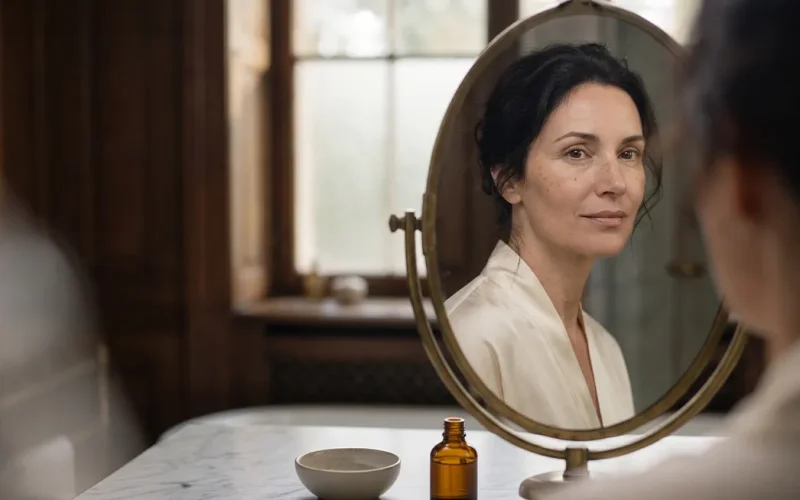
Skin ageing does not start with the first visible line. It is a quiet, gradual process that begins in the late twenties — collagen production slows, cell renewal stretches out, and skin no longer holds moisture quite as efficiently as before. “Healthy ageing” of the skin is not about stopping that process. It is about supporting it consciously — with a routine that fits the life stage you are actually in.
This guide shows what your skin really needs in your 30s, 40s and 50s, which ingredients make a measurable difference, and where the Physio Radiance range from QN Europe fits into that approach.
What “healthy aging” really means for your skin
“Healthy aging” is not a marketing slogan. It is an approach that shifts the focus away from chasing wrinkles toward a more holistic view of skin health. Four pillars sit at the centre — regardless of your age.
- Hydration: the skin’s ability to hold water. It decreases measurably with the years.
- Elasticity: how well skin springs back after movement. Driven mostly by collagen and elastin.
- Barrier: an intact skin barrier keeps irritants out and moisture in.
- Renewal: cell turnover slows with age — from around 28 days in your 20s to 40–60 days by your 50s.
A well-thought-out routine works on all four at once. That is the same idea behind the Swiss-developed Physio Radiance Skincare line, which combines innovative formulas with advanced technology.
The four steps of an effective routine
Regardless of age, the structure of a skincare routine stays similar. The ingredients and frequency change — the order does not.
- Cleanse — remove the day’s dirt, sebum and residue without weakening the barrier.
- Serum — a concentrated layer of active ingredients targeting one skin concern (hydration, glow, lines, pigmentation).
- Eye care — the skin around the eyes is thinner and more sensitive. It needs its own formulation.
- Moisturiser — a cream that seals the serum and supports the barrier.
What your skin needs in your 30s
The 30s are when collagen loss starts to become noticeable. The first fine lines appear, especially around eyes and mouth. Skin looks slightly less plump, and the natural “glow” of the 20s does not return on its own.
- Main focus: hydration and antioxidants — the foundation everything else builds on.
- Key ingredients: hyaluronic acid for moisture, vitamin C as an antioxidant, niacinamide for the barrier.
- Routine extension: consistent daily care becomes the foundation — even under make-up and in everyday life.
- Eye care from now on: the delicate skin around the eyes shows fatigue and dryness first.
What your skin needs in your 40s
In your 40s, skin visibly changes. Sebum production drops, hormonal shifts affect moisture and elasticity, and smaller lines start to settle. Skin now needs more support — and more targeted ingredients.
- Main focus: elasticity, renewal, eye area.
- Key ingredients: peptides to support collagen, retinol or milder retinoids for cell renewal, advanced moisture binders.
- Useful devices: at-home facial devices like Physio Radiance Visage+ become particularly interesting in this stage — according to the brand, they help reduce the formation of wrinkles and firm facial muscles.
- Consistency over complexity: a routine you actually stick to beats an ambitious one you abandon after two weeks.
What your skin needs in your 50s and beyond
From the 50s onwards, cell renewal slows further and the drop in estrogen during menopause acts directly on collagen structure and skin thickness. The goal stops being “look younger” and becomes a skin that is healthy, cared for and in tune with the life stage.
- Main focus: richer moisture, barrier strengthening, eye area and facial muscles.
- Key ingredients: ceramides, squalane, higher-strength peptides, well-tolerated antioxidants.
- Routine: richer textures, gentle cleansing without stripping surfactants, regular eye and neck care.
- Realistic expectations: skincare can visibly improve skin — it cannot rewind it to your 30s, and that is not what it is for.
Active ingredients that matter at any age
| Ingredient | What it does | When it really matters |
|---|---|---|
| Hyaluronic acid | Binds water in the upper skin layers and gives a plumper look | Any age — a foundational hydrator |
| Vitamin C | Antioxidant, brightens tone, supports collagen synthesis | 30s and 40s — preventive and brightening |
| Niacinamide | Strengthens the barrier, regulates sebum, calms redness | Any age — especially for sensitive skin |
| Peptides | Signal the skin to produce more collagen | Late 30s onwards — elasticity and firmness |
| Retinol / retinoids | Accelerate cell renewal and smooth fine lines | 30s and 40s — at night, with a build-up phase |
| Ceramides | A natural part of the skin barrier, holds moisture in | 40s and beyond — when the barrier weakens |
For deeper background on individual ingredients, the resources of the British Association of Dermatologists are a reliable reference point.
Where Physio Radiance fits in this picture
The Physio Radiance brand is part of the QN Europe family and developed in Switzerland. It is built around the idea of healthy skin ageing and includes three lines that cover different needs.
- Physio Radiance Skincare — the skincare line for healthy ageing. According to the brand, it cleanses the skin thoroughly, increases skin elasticity and cares for the eye area.
- Physio Radiance Visage+ — an at-home facial device. It is aimed at users who want to add a technology-led step to their routine, with a focus on wrinkle reduction, brightening of age spots and firming of facial muscles.
- Physio Radiance Expert — developed to help restore the skin’s natural glow and elasticity, with particular attention to the eye area.
No routine replaces the basics — sleep, water, a life in which the skin gets to rest. Actives and devices make the difference at the margins, not at the centre.
Frequently Asked Questions
At what age should I start “anti-ageing” skincare?
Rather than a fixed age, the cue is when you start noticing visible change — usually late twenties to early thirties. Moisture and consistent care make sense at any age. Active ingredients like retinol or peptides usually become interesting from your late 30s onwards.
Do I really need a separate product for the eye area?
The skin around the eyes is much thinner and reacts more sensitively to active ingredients. A dedicated eye product is gently dosed and often targets concerns like dark circles or dryness. For many people it is worth it — especially from the mid-30s.
How quickly will I see results from a new routine?
Hydration and glow often improve visibly within two to four weeks. For structural concerns like fine lines, elasticity or pigmentation, three to six months of consistent use is a realistic timeframe.
Can a device like Physio Radiance Visage+ replace creams?
No. Actives and creams nourish the skin; a device supports it on a different layer through a dedicated technical function. Both layers work most effectively together.
Is a small routine enough, or does it need to be elaborate?
A small routine consistently followed beats an elaborate one that ends up forgotten in a drawer after three weeks. The classic at any age — cleanser, moisturiser, targeted active — is also the most robust starting point.
The bottom line
Healthy skin ageing is less a question of finding the perfect product and more about consistency, the right order, and an honest sense of what skincare can actually do. Your 30s, 40s and 50s call for different priorities, but the underlying logic stays the same: care, hydrate, support where it matters.
If you want to build this approach with a developed product family, the Physio Radiance range and its three lines — Skincare, Visage+ and Expert — are a good place to start.